Walkboutr: Extracting ‘Walk Bouts’ from GPS and Accelerometry Data for Physical Activity Research

Walking is a common form of exercise and a popular intervention of interest for population health researchers. GPS devices and accelerometers, which can be worn by study participants to provide accurate information on walking duration, speed, and intensity, are an efficient and cost-effective method for measuring walking characteristics Troped et al. (2008). The outcome of research on walking can inform policy related to health communication, medical interventions, and built environments. However, data collected by these devices have two main drawbacks: they require intensive data preprocessing to identify walking periods, and they may contain identifying personal information, limiting storage and shareability options. To address these challenges, we have developed an R package, walkboutr, to identify walking periods within monitoring data and to create de-identified summaries of walking characteristics that can be used to answer research questions related to walking.
Related Denominator 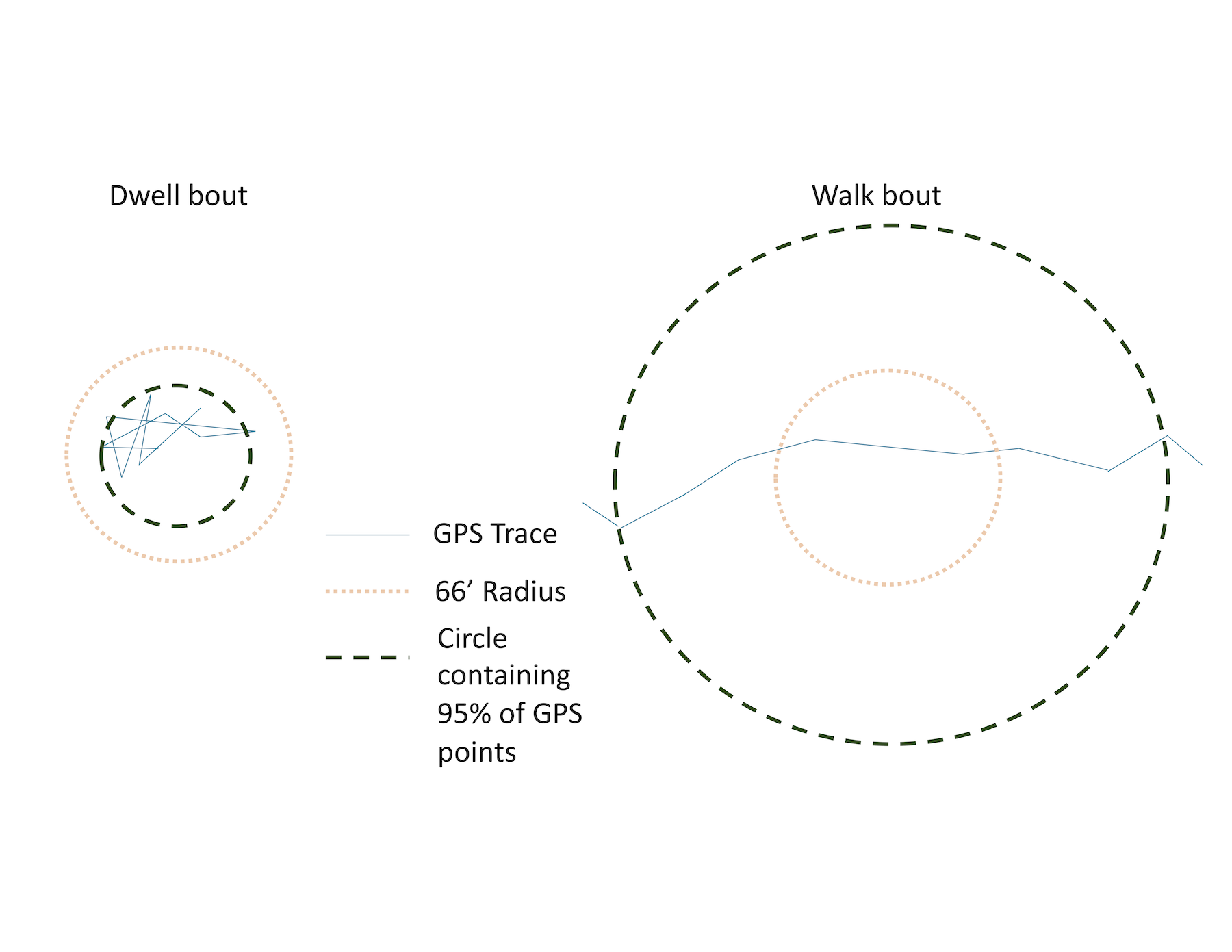 Walkboutr: Extracting ‘Walk Bouts’ from GPS and Accelerometry Data for Physical Activity Research Walking is the most common form of physical activity and a behavior of key interest for urban planners, health promotion researchers, and rehabilitation medicine practitioners. Data collected from monitoring devices, such as Global Positioning System (GPS) trackers and accelerometers, hold considerable public health research potential. By analyzing patterns in individual energy expenditure and movement… read more
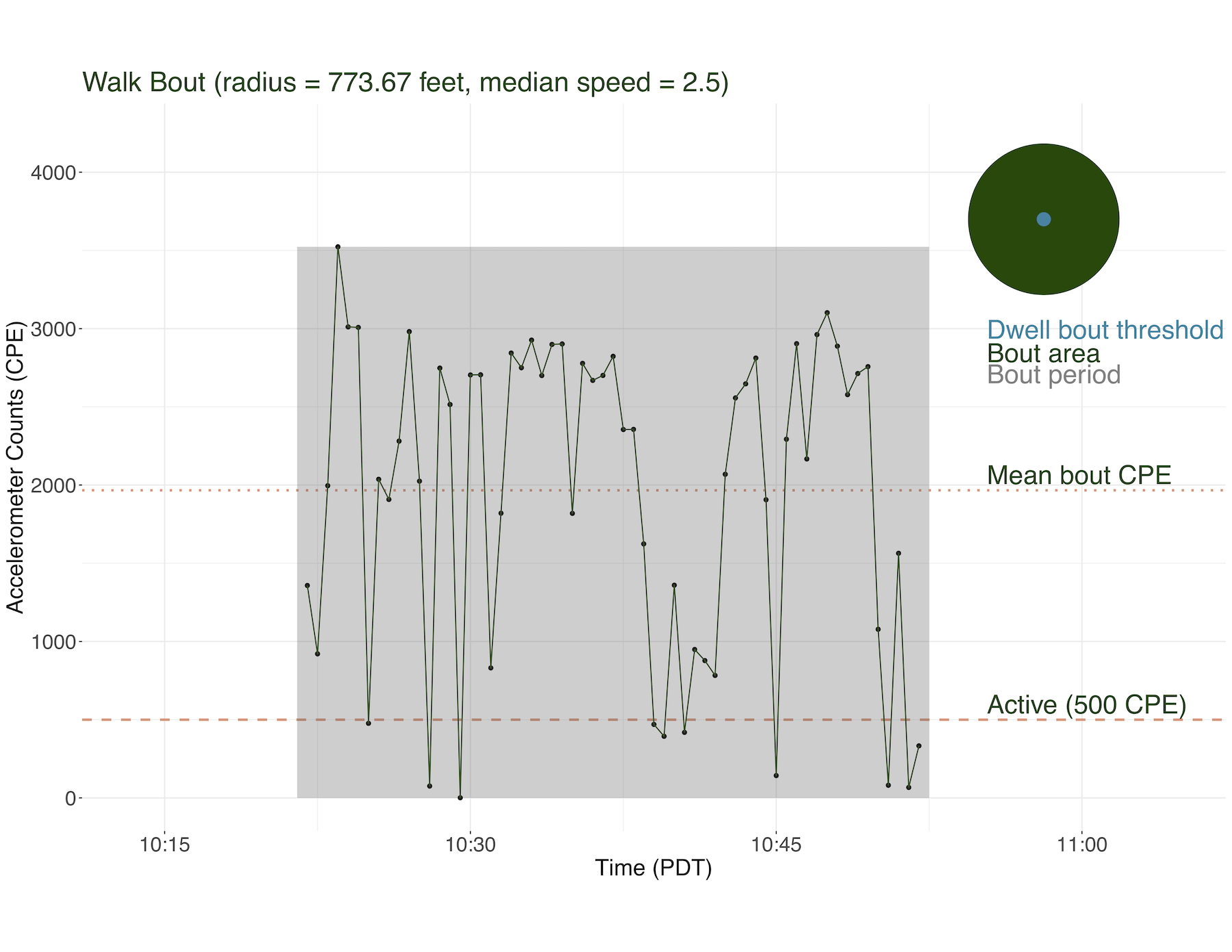
walkboutr defines periods of walking (or other activity) based on pre-specified, but adjustable, parameters from GPS and accelerometry data. The main data components used to identify walking are speed, activity level, and distance traveled measured by accelerometers and GPS devices. walkboutr splits raw accelerometry data into small discrete time chunks or epochs (defaults to 30 seconds), and then aggregates these chunks into physical activity bouts when movement rises above a minimum activity threshold for a minimum number of sequential epochs. The algorithm defines walking as periods of activity where the counts per epoch, or level of activity, fall within a pre-specified range consistent with walking (Figure 1) (Kang et al., 2013).
Once the algorithm identifies a sequence as potentially walking, it then defines the period as a walk bout if the GPS trace indicates travel outside a specified radius. This allows the researcher to distinguish periods of walking from running or other high-intensity exercise, as well as from periods where a person may be moving (e.g., doing chores around the house) but not specifically walking. One major benefit of walkboutr is that parameters defining walk bouts are set at reasonable defaults, allowing for comparison across studies, but they can be changed by the user. This grants researchers flexibility in answering specific questions about walking characteristics as well as an easy way to conduct sensitivity analyses on walking definitions.
Once the data are processed in walkboutr – and walking periods, or walk bouts, are defined – a full dataset is created that includes the raw data with the newly created bout definitions attached to each observation. In addition, a second summary dataset of walk bouts is created. These data are deidentified (i.e., time and location are removed) but include relevant walking information, such as distance traveled and time spent walking, that can be used for analyses and shared with other researchers without worrying about compromising study participant privacy. walkboutr aims to make the measurement of walking easier and more systematic by removing barriers to researchers interested in collecting, using, and sharing individual data on walking. For those interested in additional details, please refer to the related Denominator article.
References
Computation & Reproducibility
The original repository maintained by Lauren Wilner can be found here: https://github.com/rwalkbout/walkboutr. Note: this repository is maintained by Lauren Wilner and may differ from that originally used to produce the results in this publication.
Citation
@article{wilner2026,
  author = {Wilner, Lauren Blair and Zhou, Weipeng and Hurvitz, Philip
    M. and Moudon, Anne V. and Kang, Bumjoon and Saelens, Brian E. and
    Phuong, Jimmy and Dekker, Matthew and Mooney, Stephen J.},
  publisher = {Population Dynamics Lab},
  title = {Walkboutr: {Extracting} “{Walk} {Bouts}” from {GPS} and
    {Accelerometry} {Data} for {Physical} {Activity} {Research}},
  date = {2026-03-16},
  url = {https://population-dynamics-lab.csde.washington.edu/the-download/2026/wilner_walkboutr/},
  doi = {DOI pending},
  langid = {en}
}